Tjanpi Desert Weavers at 30: Indigenous Women in Central Australia Weave Culture into High Art
- Aug 6, 2025
- 3 min read
6 August 2025
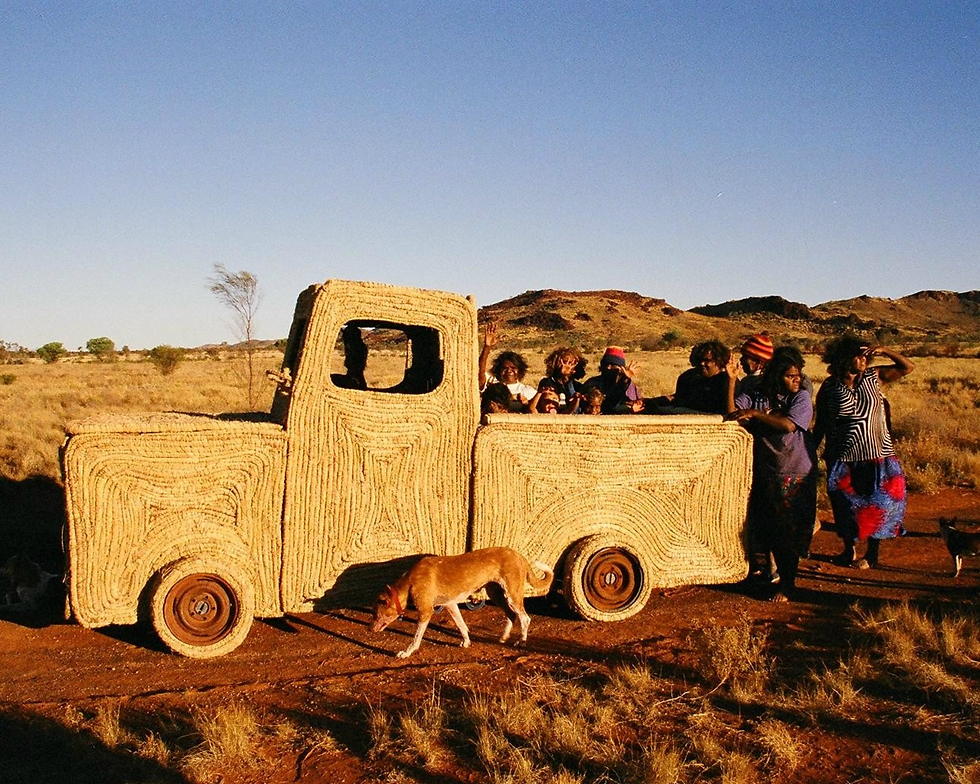
The Tjanpi Desert Weavers collective, celebrating its 30-year anniversary in 2025, represents a thriving Indigenous‑led social enterprise uniting over 400 women from 26 remote communities spread across 350,000 square kilometres of central Australia. What began in 1995 as modest basket‑weaving workshops on Ngaanyatjarra, Pitjantjatjara and Yankunytjatjara lands led by the NPY Women’s Council has flourished into a globally exhibited practice that merges cultural survival with artistic innovation.
For many women like Julie Anderson, once a station hand and cleaner in her sixties, weaving did not come naturally at first. Under the gentle encouragement of her aunt Margaret Smith in Imanpa, she finally gave it a try and discovered a profound sense of purpose. In knitting and coiling wild‑harvested spinifex grasses into baskets and sculptural forms her face lights up, reflecting a joy she only found when weaving became part of her daily rhythm.
Their creative process connects deeply to Country. Gathering materials such as grasses, gumnuts, raffia fibres, emu feathers and native dyes is not only about art making it is about learning to hunt, gather, teach children, sing inma and reconnect with ancestral lands. These excursions into the bush bind culture, ecology and community into each expressive weave.
Each finished piece is not simply decorative. As Simon Carmichael, artistic director of the Darwin Aboriginal art fair, stated, every basket or sculpture is an act of cultural preservation and intergenerational storytelling. These works embody transmitted lore, communal memory and contemporary identity. Each form whether a life‑size animal sculpture or a refined basket is imbued with stories of place, family and survivance.
Over three decades the collective has garnered artistic acclaim. In 2005 a team of weavers won the prestigious National Aboriginal and Torres Strait Islander Art Award for a giant woven Toyota sculpture, known as the Tjanpi Toyota. Their work later featured in the Australian pavilion at the 2015 Venice Biennale in collaboration with artist Fiona Hall. Their installation “Songlines: Tracking the Seven Sisters” at the National Museum of Australia toured Europe and Asia, and later graced exhibitions in India, China and beyond.
One of the collective’s most iconic works, Kungkarangkalpa (Seven Sisters Dreaming), has become a centrepiece in major Australian art shows, including 65,000 Years: A Short History of Australian Art. Co‑curator Judith Ryan described it as a “fully three‑dimensional manifestation of a creation myth, spectacular in scale and presence perhaps the group’s magnum opus.”
At every step the collective maintains its grounding in cultural ethics. Weavers routinely teach younger women and girls how to collect tjanpi grass, spin fibres and tell stories through weaving. Gathering also includes visiting sacred sites and sharing cultural knowledge, reinforcing identity transmission even among the youngest participants. This ensemble practice provides emotional resilience, economic agency and social support.
The enterprise is not merely artistic it actively fosters livelihoods. Many weavers rely on earnings from sales to meet basic needs like groceries, fuel and school fees for their children, and describe weaving as therapeutic: “It settles the mind from all the worries,” as Margaret Smith puts it. The model exemplifies how Indigenous women’s artistry becomes cultural, emotional and economic sustenance.
What began as craft has evolved into art on the world stage. The collective’s pieces are now held in galleries and collections across Australia and internationally. From humble basket weaving to expansive collaborative sculptures, Tjanpi Desert Weavers have redefined Indigenous craft as avant‑garde art with political and aesthetic force. Their evolution challenges Western art hierarchies by asserting that women’s work, once categorized as craft, belongs at the forefront of contemporary art discourse.
As Tjanpi marks its third decade, it stands as a powerful example of how Indigenous-led practice can thrive. Through weaving the threads of Country, community and cultural memory into each form these women ensure their survivance a combination of survival and resistance embodied in fibre, colour and collective action. More than art, Tjanpi is living heritage and a beacon of creative resilience.


Comments