The Missing Picasso That Was Never Stolen: How a Forgotten Crate Solved a €600,000 Mystery
- Oct 24, 2025
- 3 min read
24 October 2025
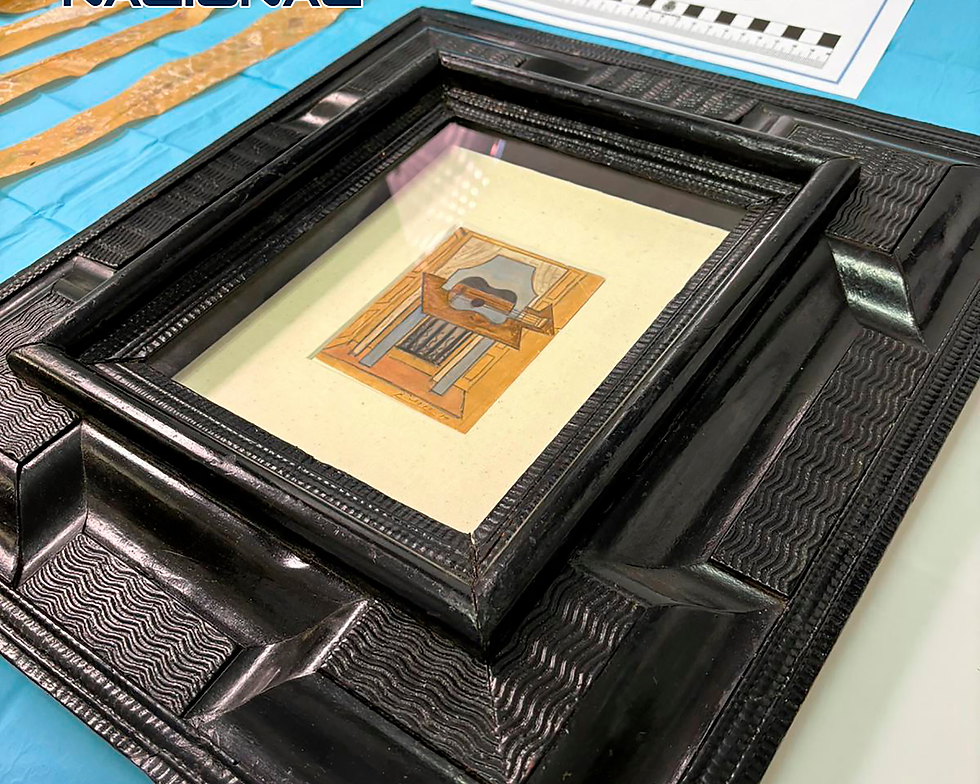
Tiny but iconic, a 1919 painting by Pablo Picasso titled Still Life with Guitar valued at around €600,000 was recovered this week after vanishing en route to an exhibition in southern Spain, concluding a case that authorities say never involved a grand heist but rather a baffling mishap in transportation.
The artwork was due for display at the CajaGranada Foundation in Granada as part of its show Still Life: The Eternity of the Inert when, on arrival from Madrid in early October, curators realised one of the 58 loaned pieces was missing. Surveillance and logistics records revealed that the truck carrying the works delivered 57 crates but Still Life with Guitar was not among them.
Spanish authorities now say the explanation is far less dramatic than a daring theft. According to the investigation, the painting may have never been loaded onto the transport van, and instead remained behind at the building in Madrid from which it was picked up. A neighbour apparently found the unattended cargo, believed it to be a misplaced delivery, took it in, and only later realised the gravity of the item she was holding and alerted police.
The work in question is small in size measuring just around 12.7 by 9.8 centimetres yet its value and provenance make it a high-stakes object. Painted in gouache and pencil, it represents a still life of guitar and everyday objects crafted by Picasso during a post-Cubist phase of his career.
Key to the confusion was poor packaging labelling. The foundation responsible for the exhibition admitted that while the artworks were carefully boxed, many packages were not correctly numbered, making it impossible to conduct a thorough check in the delivery phase. After the van arrived on October 3, it was signed off; unpacking began only on October 6, by which time it became clear the Picasso had not arrived.
Once police recovered the painting from its unintended interim location, forensic experts from Spain’s historical heritage unit opened the package under sterilised conditions to verify authenticity and condition. Investigators note that while no crime has yet been formally charged, the investigation remains open.
Despite the ordeal, the exhibition still plans to proceed with the piece now back where it belongs. The foundation has expressed relief at the recovery but also underscored that the incident serves as a cautionary tale in the transport and handling of valuable loaned artworks.
For the art-world at large this incident underscores multiple vulnerabilities: the reliance on logistics and shipment processes for museum displays, the consequences of seemingly small errors in handling high-value objects, and the importance of robust audit trails for cultural property. Even though the painting was never dramatically stolen, the moment of disappearance exposed how easily a masterpiece can slip out of view without, in fact, ever leaving the building of origin.
While many art theft stories involve dramatic midnight break-ins or high-profile criminal networks, this one is quietly striking: the missing Picasso was never stolen, just misplaced. In this way the incident is less about daring crime than about human and procedural error in the chain of transport a reminder that in the art-world, the greatest hazards can sometimes be the mundane ones.
In the long term the incident is likely to prompt tighter protocols around package tracking, numbering, sign-offs, and delivery verification for loaned artworks. Institutions may re-examine the logistics side of exhibitions as much as the curatorial. Meanwhile, for Picasso’s mystique this little painting once gone, now found is a story in itself of how even masterpieces can take unexpected detours.


Comments