Inside LACMA’s Controversial New Geffen Galleries
- Jun 28, 2025
- 3 min read
28 June 2025
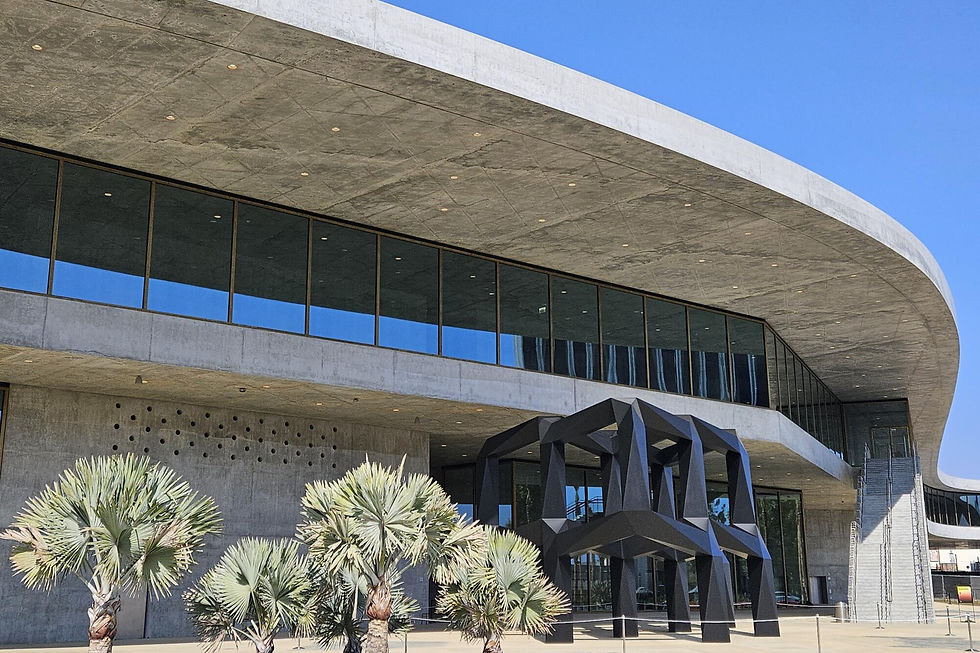
Los Angeles is poised for a major cultural shift with the near-completion of the David Geffen Galleries at the Los Angeles County Museum of Art (LACMA). Designed by Pritzker Prize winning architect Peter Zumthor and set to launch in April 2026, this $720 million structure replaces four aging museum buildings with a single, monolithic slab of poured concrete that straddles Wilshire Boulevard. Enthusiasts see an architectural milestone, while critics question its practicality and aesthetic direction.
From the street below, the building appears as an enormous “dinosaur egg” perched on stout concrete legs. Its top level meanders over the boulevard with sweeping curves and wraparound glass that flood the galleries with light. CEO Michael Govan describes the vision as “reinventing art history for the 21st century,” rejecting linear curation in favor of a park-like setup that invites exploration rather than instruction. Proponents like Brad Pitt and Architectural Digest have praised the dynamic spaces and bold aesthetic.
But the critics have been equally vocal. They have derided the raw form as an “amoebic pancake,” questioning how paintings will be hung on its rough concrete walls. Pulitzer-winning critic Christopher Knight has branded it “the Incredible Shrinking Museum,” noting a reduction in gallery space and the impracticality of hanging artwork on concrete without constant drilling and patching. One donor publicly withdrew support, and Zumthor himself distanced from the final execution, citing compromises and escalating costs.
Proponents counter that heavy-duty concrete offers durability and permanence. Govan points out that steel anchors can be drilled into concrete, and patched later akin to blue jeans that improve with age. The open layout, supported by large glass walls, allows visitors to “wander through art” while maintaining sightlines to city landmarks like the La Brea Tar Pits and the Academy Museum.
The structure’s Brutalist aesthetic, a homogeneous spread of concrete across 90 bunker-like rooms and corridors draws sharply divided reactions. Inside, some visitors are struck by its raw, minimalistic power; others feel overwhelmed by the visual monotony and harshness. Floor-to-ceiling glass will provide relief, but only once curtains are installed to mitigate the harsh Californian sun.
Construction on the galleries began after the demolition of LACMA’s original structures in 2020 and has faced multiple delays. Along the way, fossil discoveries and seismic design requirements added complexity and cost. A later decision to shift from initial black façade plans to raw concrete signaled the cost-saving priorities that have defined the project.
Despite doubts, LACMA is already planning public engagement leading up to the full 2026 opening. Summer 2025 will see parts of the plaza activated with restaurants, a store, outdoor sculpture installations, and an early series of performances by jazz musician Kamasi Washington. Once open, the galleries will operate without a main entrance or linear path, allowing visitors to interpret the collection non-hierarchically. Future shows will be organized by theme, such as oceanic art, rather than by period or geography.
As LACMA navigates the balance between innovation and expense, the departure of several senior staff including the COO, CFO, and the deputy exhibitions director adds to the uncertainty. Critics wonder whether the museum's leadership has bitten off more than it can chew.
At stake is a transformation of LACMA into more than a museum, it aims to become a landmark destination in the mid-Wilshire cultural corridor. The success of the idea will unfold as galleries fill and audiences respond. For now the David Geffen Galleries remain a bold architectural experiment that challenges assumptions about how museums should look, feel, and function in the modern era.


Comments