Exploring the unseen genius of Renoir’s drawings in a major New York exhibition
- Oct 18, 2025
- 3 min read
18 October 2025
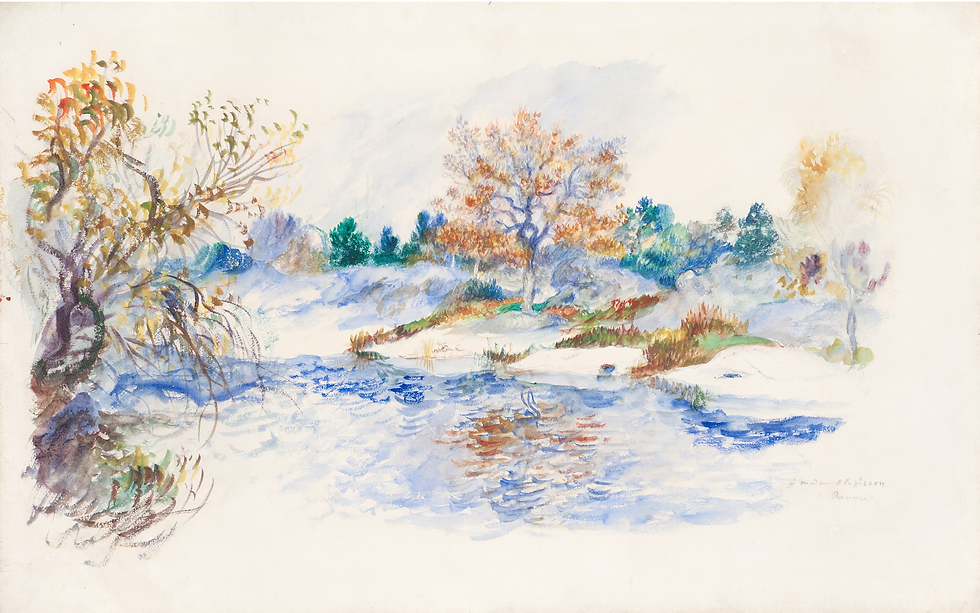
At the heart of New York’s fall museum calendar, the Morgan Library & Museum presents Renoir Drawings, a landmark exhibition bringing together more than 100 seldom-seen works on paper by Pierre‑Auguste Renoir and revealing the depth of an artist best known for his glowing painted canvases. Curated by museum director Colin B. Bailey, the show is the first in over a century dedicated exclusively to Renoir’s drawings, pastels, watercolours and prints.
Born in Limoges in 1841 and working for much of his career in Paris and the Riviera, Renoir is celebrated for figures of light and colour that helped define Impressionism. But what this exhibition uncovers is the less familiar side of his practice: the scratch of chalk, the brush of ink, the quiet labour of studies and sketches through which the iconic paintings were born. Bailey underscores this by curating a chronological survey of Renoir’s on-paper work, inviting viewers to trace his evolution from student drafts through Parisian life, to his later Arcadian nudes and landscapes.
The works form constellations: early anatomical studies, urban and rural scenes, portraits of family and friends, preparatory sketches for major compositions. Key pieces include studies for Dance in the Country (1883) and The Great Bathers (1886-87). Remarkably The Great Bathers, on loan from the Philadelphia Museum of Art and making its New York debut, sits alongside its associated preparatory drawings offering a rare opportunity to witness the full continuum of creation.
Renoir’s turn toward themes of feminine form, family, and serenity is reflected in the works on display. Moving away from the bustle and grit of urban life, he embraced a world of warmth, ease and natural beauty: women resting, children playing, landscapes suffused with light. Bailey explains this shift as a distancing from the awkwardness of early Impressionist transgression and a turn toward something more enduring and comforting.
Yet the technical elegance and variety of his drawing media also matter. The exhibition showcases chalks in red, black and white, washes of ink, pastel on paper and delicate watercolours. These works reveal Renoir as a draftsman of “the first order,” not just a painter whose vivid canvases were his legacy. “You get a real sense of how he develops and the different stylistic moments in his career,” Bailey observes.
The timing of the exhibition is significant. Many of the drawings are fragile and have seldom left storage or their original institutions. The gift of a large-scale preparatory drawing for The Great Bathers, acquired by the museum in 2018, helped catalyse the project. It opened the possibility of examining Renoir’s paper-based work at scale and in depth.
Among the standout pieces are delicate pastel portraits such as Portrait of a Girl (Elisabeth Maître) (1879), from Vienna’s Albertina; intimate late-period sketches of his wife Aline and their sons; and a plaster sculpture titled The Judgement of Paris (1914) a collaborative work realised when arthritis limited Renoir’s mobility, yet still rooted in his draft drawings.
The exhibition thus moves beyond a simple show of pretty things: it positions drawing at the core of Renoir’s process, casting light on how the paintings came about and deepening appreciation of his versatility. It also asks us to look differently at an artist often viewed through his most accessible works. His drawings are quieter, less familiar, but no less revealing.
For visitors the effect is two-fold. First, there is the innate pleasure of encountering a name as familiar as Renoir in unexpected media. Second, there is the realization that much of what we admire in his paintings, the balance, the gesture, the light was first worked out on paper. As Bailey says: “Drawings help you see the germ of ideas.”
The show will travel to the Musée d’Orsay in Paris following its New York run, underscoring its significance on both sides of the Atlantic. For those in New York it remains on view at the Morgan through 8 February 2026, offering time to experience a dimension of Renoir’s work that is insightful and, until now, understated.


Comments