David Hockney’s iconic portrait rekindles memories of love, art, and a bygone Californian salon
- Oct 8, 2025
- 3 min read
08 October 2025
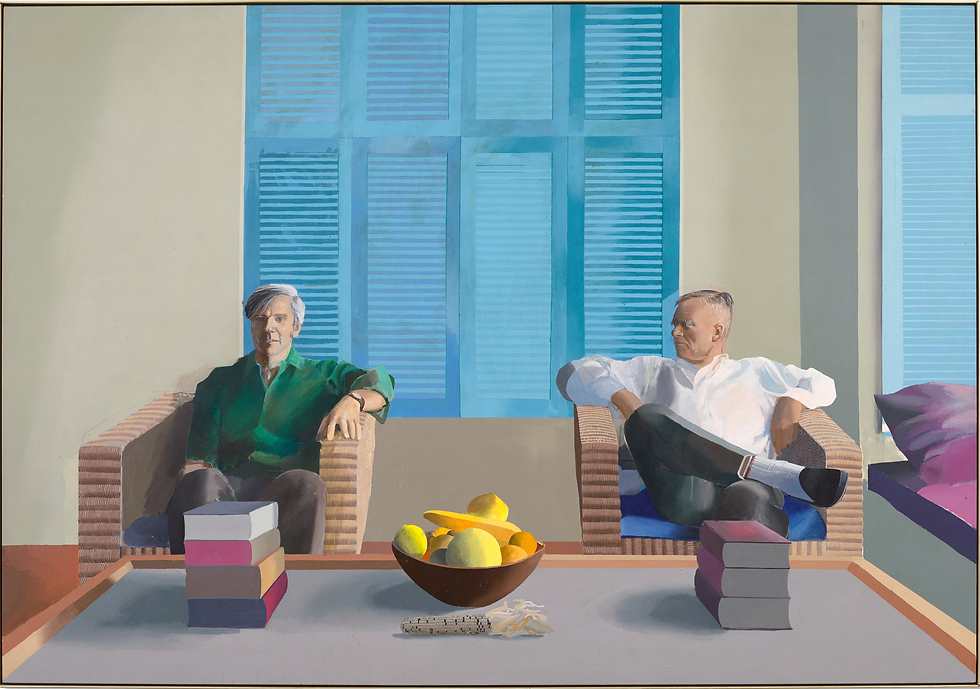
At 91 years old, the artist Don Bachardy leans back in his chair and lets out a hearty laugh over the phone as though recalling a bright young memory: “It was a very long time ago,” he says, voice rasping with age and lived experience. His recollections are evocative and expansive of art, friendship, love, creative exchanges, communal salons, and a single painting that captured all of it. That painting is Christopher Isherwood and Don Bachardy, executed by David Hockney in 1968, a monumental double portrait now headed to auction with a projected price tag of £45 million.
Hockney’s canvas presents two figures reclining in their Los Angeles living room: Isherwood on the right, glancing toward Bachardy, and Bachardy gazing out each invested in a quiet dialogue. The domestic setting is rich with stabilizing geometry: a low table laden with books and fruit, chairs aligned in symmetry, subdued light from shuttered windows all composed with an inner calm that belies the tumultuous social margins into which this portrait would emerge.
Yet this serene presentation was itself radical. Painted amid a period when same-sex relationships remained stigmatized and legally constrained, the work stakes a claim to visible, everyday reality. It does not dramatize queer love. Instead it normalizes it by placing it in the ordinary in a room, in chairs, in domestic life. The painting draws strength from banality: it insists that gay life deserves neither secrecy nor spectacle.
As Bachardy recounts his decision to sit for Hockney, he remembers the painter’s calm confidence, his unwillingness to rush, and his belief that beauty requires time. For Bachardy, a trained artist himself, sitting was a familiar ritual. He and Hockney had mutual respect they even sat for one another occasionally. Bachardy says he never wavered in his conviction about the painting. “I expected the best and I got it,” he says.
Over the decades Isherwood and Bachardy’s Santa Monica home became a salon a place alive with writers, actors, thinkers. Bachardy laughs that he can’t recall exactly who all came and went during those years but among the guests were names like Bette Davis, Tennessee Williams, Marlene Dietrich, and Truman Capote. The house remains in Bachardy’s possession, now held in trust, and may serve as a future artist’s residence continuing its legacy of cultural exchange.
Now in the autumn of his life, Bachardy still lives there. He paints portraits nearly daily. Regarding the house, he admits his feet get “itchy” but its roots are deep. To leave it would feel like losing a part of himself. When asked whether the chairs from Hockney’s painting still exist, he says they survive in storage. Perhaps one day they will return to the home as artifacts of its history.
The upcoming Christie’s auction in New York casts a new spotlight on the painting’s significance. This is not only a transaction in the art market but a reckoning with cultural memory and queer history. Hockney’s work found renewed prominence in the major “David Hockney 25” exhibition in Paris, where this very portrait served as a touchstone of his double-portrait series.
This painting’s importance transcends price. It stands at the confluence of intimacy and publicness, personal and collective histories. In 2025, as queer art is more prominently acknowledged and reevaluated, Christopher Isherwood and Don Bachardy functions not just as a beautiful object but as a quiet defiance. It is a testament to lives lived in light, to love that endured, to the enduring potency of stillness as resistance.


Comments