Chiharu Shiota Weaves Emotion and Memory into “Home Less Home” at Boston’s ICA Watershed
- Jun 3, 2025
- 2 min read
Updated: Jun 4, 2025
26 May 2025
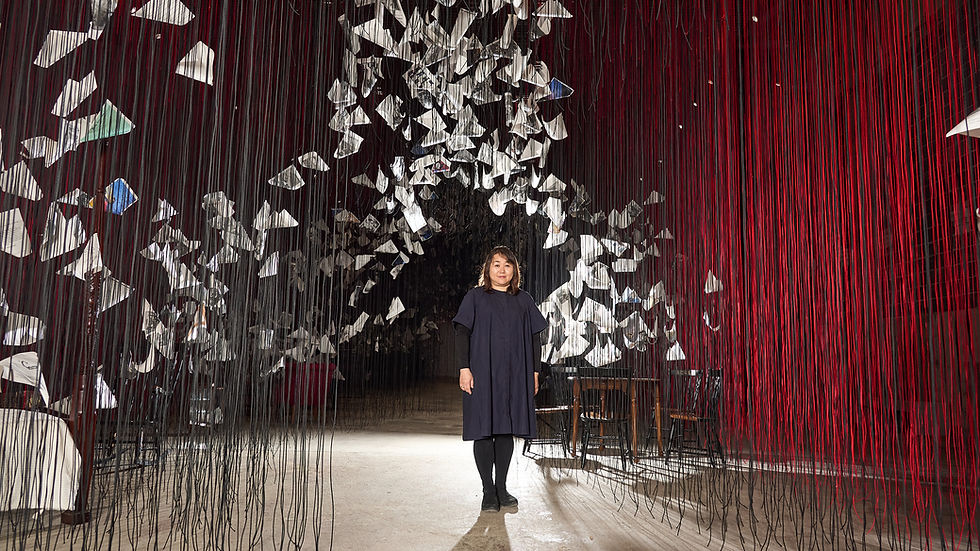
The hauntingly beautiful works of Japanese artist Chiharu Shiota have arrived in Boston, offering a powerful meditation on home, memory, and identity. Her latest exhibition, Home Less Home, is now on display at the Institute of Contemporary Art (ICA) Watershed in East Boston from May 22 through September 1, 2025. The installation not only marks Shiota’s New England debut but also stands as a centerpiece of the city’s inaugural Boston Public Art Triennial, a wide-reaching festival centered on the theme “The Exchange.”
Shiota, best known for her large-scale installations involving intricate webs of thread, brings a deeply personal and universal perspective to this immersive project. Having moved from Japan to Berlin nearly three decades ago, Shiota draws upon her own feelings of displacement and cultural migration to explore what it means to belong and what it feels like to not.
As visitors enter the ICA Watershed, a former industrial facility turned contemporary art space, they are immediately met by Shiota’s iconic use of red yarn. Dozens of weathered suitcases hang suspended in mid-air, all interconnected by a network of ropes. This piece, titled Accumulation – Searching for the Destination, first created in 2014, has evolved over time and now resonates more deeply as global discussions around migration, asylum, and displacement dominate headlines.
The vibrating suitcases and subtle motion powered by motors are meant to evoke not just physical travel, but the anxiety, hope, and tension that accompany leaving one place in search of another. For Shiota, who left Japan with just one suitcase to start a new life in Germany, these symbols serve as an echo of both freedom and loss. The suitcases feel like ghosts in mid-flight caught in transit, but never quite arriving.
The highlight of the exhibit is the titular installation, Home Less Home, a newly commissioned work that transforms the vast Watershed space into an emotional experience. Constructed with thousands of strands of red and black yarn, the piece resembles a skeleton of a home suspended in time. Inside, domestic items such as beds, chairs, and desks are suspended in a dense web, alongside actual documents from Boston-area residents: old passports, immigration papers, letters, birth certificates, personal artifacts that give voice to lived experiences of uprooting, settling, and redefining one’s place in the world.
What makes the exhibition especially powerful is the public's involvement. The ICA put out a call for residents to donate meaningful personal documents, and the response was overwhelming. These community contributions now woven into the installation turn the artwork into a collaborative archive of stories that transcend nationality and language. Visitors are not just observers; they are emotionally pulled into the histories that bind people to place.
Entry to the ICA Watershed is free, and visitors can take advantage of a water shuttle that connects the space with the museum’s main location in Boston’s Seaport. This connection between water, travel, and movement feels poetically appropriate given the exhibit’s themes.
Shiota’s work doesn’t shout, it whispers through thread, memory, and emotion. Home Less Home reminds us that home isn’t always where we come from, it's often where we’re still trying to go.


Comments