Alan Hollinghurst reflects on the tragic brilliance of Denton Welch
- Oct 13, 2025
- 3 min read
13 October 2025
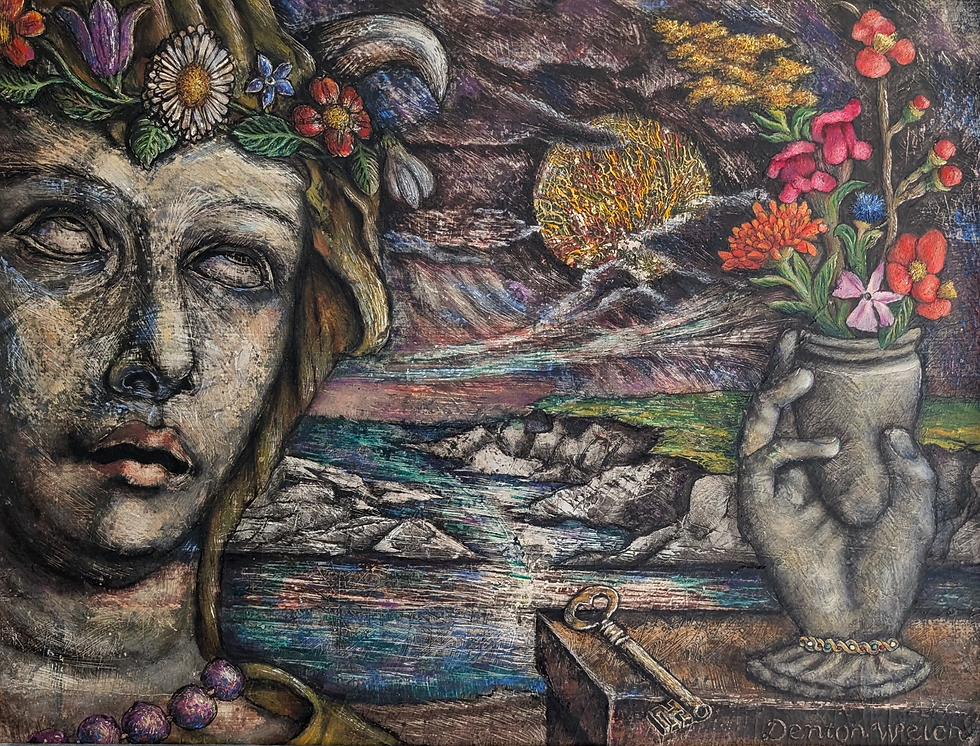
In a recent reflection, Novelist Alan Hollinghurst revisits the short, luminous life of painter and writer Denton Welch, celebrating his fierce creativity, his heightened sensitivity, and the sense that from tragedy emerged a distinctive artistic voice that continues to resonate.
Welch was born in 1915 in Shanghai to an English father and American mother, relocating to England at age four, where he would grow into a precocious talent. From his earliest writings one senses a restless observer attuned to sensations both external and internal with an urgency to record how things felt as much as how they appeared. In Maiden Voyage (1943), which describes his return to China after running away from school, the vividness with which he describes sensation, memory and dislocation already marks him as a singular presence in 20th-century letters.
Hollinghurst underscores a central tension in Welch’s work: a ceaseless hunger for visceral experience paired with a yearning for fragility and beauty. Welch collected porcelain, shells, objects he built intimate worlds of objects and detail. He would revisit the same still lifes in his paintings and drawings, each time magnifying the emotional valence of things and their associations. His aesthetic was never about cool minimalism but about accumulation and layering, about letting memory, imagination, and sensory detail encroach upon each other.
Then came a turning point: in 1935 Welch was struck off his bicycle on a country road near Tunbridge Wells. He suffered severe spinal injuries and internal trauma, which left him bedridden, suffering, and unable to walk. The accident truncated his physical freedom but paradoxically opened new creative space: he turned inward and began writing A Voice Through a Cloud, his last, unfinished work, chronicling months in hospital, decline, memory, and the act of observing life from the margins.
Hollinghurst notes that the collision of body and art is central to how we remember Welch. His books are haunted by loss, loss of youth, loss of ability, loss of normalcy but also insist on presence, perception, and the force of imagination. His paintings, likewise, are imbued with a kind of emotional propulsion: they may begin with a vase of flowers but evolve in unpredictable ways, adding elements that shift mood, shadows, odd forms. In them, the boundary between memory and projection blurs.
In discussing the current exhibition of Welch’s artworks at John Swarbrooke Fine Art in London (running through October 30), Hollinghurst describes how seeing these paintings now feels like standing in a live echo of his prose: the images carry the same insistence on the charged detail, mystery, and internal life that Welch’s writing always carried. The exhibition offers a chance to recover not only his best known works but the surprise of variations, smaller drawings, and objects he embedded in memory and art.
Reflecting on Welch’s legacy, Hollinghurst suggests that the real shock is how wholly original his voice remains almost eight decades later. Welch was never part of any school; his integrity lay in extreme sensitivity to place, object, memory, self and the will to compress that into art and literature. He writes: we read Welch not to divine genius so much as to come alive to what it is to live in the quarters of sensation, to perceive what others might skip over.
To Hollinghurst, what endures is not the tragedy of what Welch lost but the vividness of what he offered: a way of seeing and feeling that was uncompromising, alert, and full of the tensions of body, desire, belonging, and solitude. The fact that Welch’s life was cut short he died in 1948 at age 33 only heightens the sense of what might have been, but does not eclipse what remains.
In these pages, Hollinghurst invites readers to approach Welch not as a tragic footnote but as an ongoing conversation: with his work, his vision, and the emotional risks of art itself. His voice remains alive in the places where he insisted others look at objects, memory, sensation, and the spaces between.


Comments